




Transforming the built environment
Reaching net-zero goals requires faster, smarter building upgrades. The technical tools exist, but many organizations still face fragmented data, complex processes, and difficult planning decisions.
IBDT works to simplify this journey by combining data, analytics, and user-centered tools. We help stakeholders evaluate options, compare outcomes, and plan practical decarbonization pathways with more confidence.
Mission
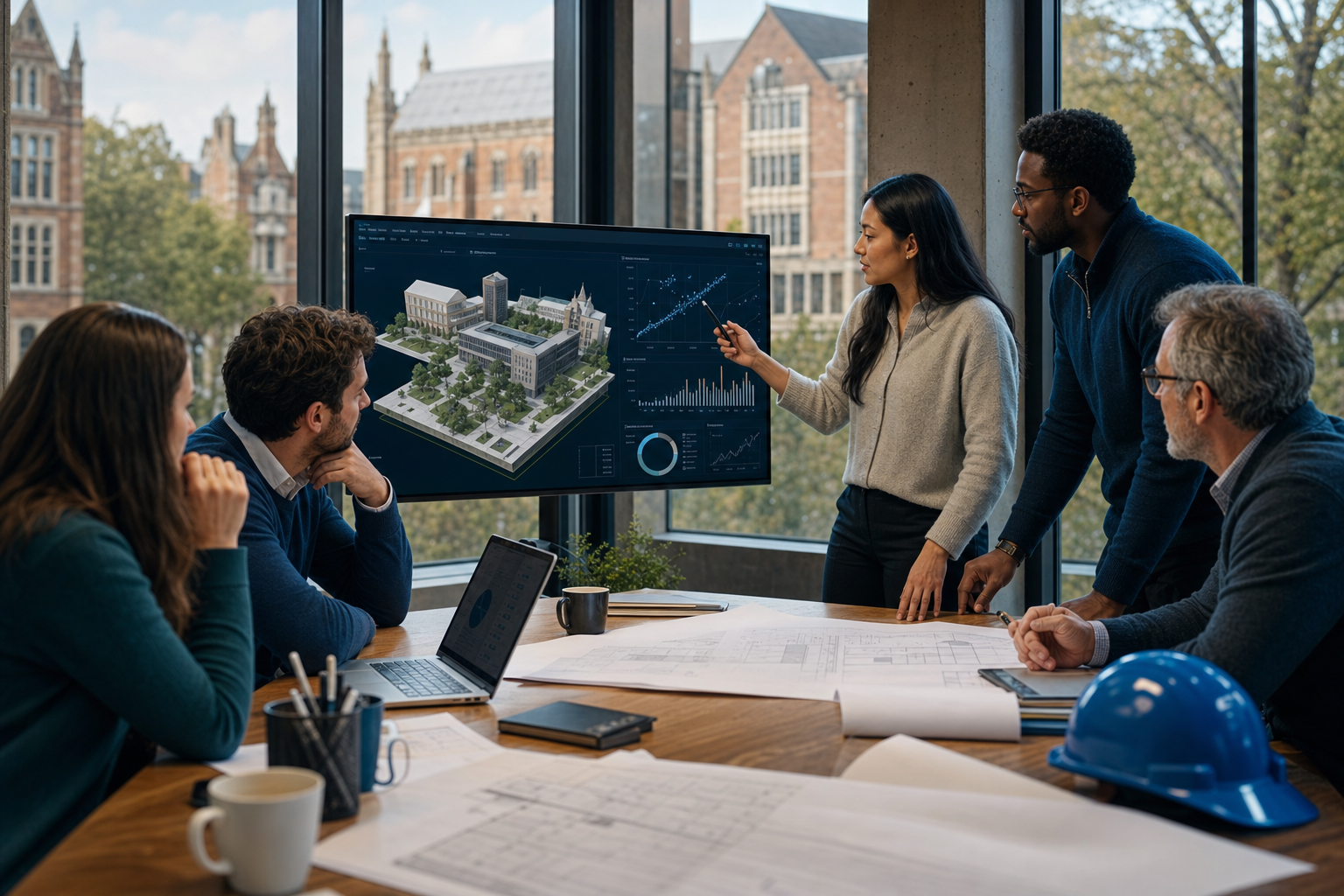
Our mission is to improve building decision-making through data science, occupant engagement, and process automation. We treat digital twins as collaborative environments where teams can test options virtually before applying them in real operations.
Vision
We envision digital twins that go beyond monitoring and prediction. IBDT focuses on prescriptive and generative capabilities that help users compare scenarios, select better actions, and improve both building performance and occupant wellbeing.
Objectives
Our work is centered on three themes: better data access, stronger analytics, and meaningful organizational change.
Digitization and Access Management
IBDT aims to develop technical and administrative work process for creating digital representations of physical buildings; and, more importantly, embed this data into computational platforms to simulate, anticipate, and design real-world operational schemes for buildings. In other words, this process of digitization consists of bringing what is “real” into the digital world and – subsequently – extracting the insights obtained from the “digital twin” to enhance the actual (i.e., real-world) performance of the built environment.
Effective digitization combines multiple data types, including IoT, operational, management, and user input. It can also include technical models such as BIM, predictive maintenance models, and energy simulations.
To support this work, IBDT is creating a campus data portal with access to structured and unstructured facility data, including historical, real-time, and scenario-based information.
Our objective is not only data access, but also data usability and governance. We focus on clear access policies, reliable data quality, and transparent data-sharing practices that support better decision-making.
Virtualization and Business Intelligence
Many people associate digital twins only with digitization. At IBDT, we also focus on virtualization: using data to explore future scenarios and better operational choices.
We give equal weight to business processes and user needs, not only technical systems. This helps improve efficiency, sustainability, and occupant wellbeing.
Our goal is to turn analytics into business intelligence through clear visualizations, practical workflows, and decision-support tools. The UofT digital twin supports descriptive, predictive, and prescriptive analytics for real operations.
Empowerment and Organizational Transformation
This theme focuses on changing how buildings are operated and managed, starting at UofT and extending to the broader built asset sector.
We aim to move stakeholders from passive information users to active solution creators, enabling occupants and operators to shape innovations that improve both operations and user wellbeing.
This aligns with a citizen science approach, where community members, researchers, and professionals collaborate to produce practical knowledge for healthier, smarter, and more resilient cities.
| Research Team | |||
|---|---|---|---|
Dr. Tamer El-Diraby IBDT Director |
|||
Soroush Sobhkhiz PhD Candidate |
Anthony Ortiz BIM & Virtualization Coordinator |
||
Yusong (Bill) Tang Project Manager, PhD Candidate |
Theohar Konomi Chief Software Architect |
||
Amirhossein Babaei Ravandi PhD Candidate |
|||
| Partners & Collaborators | |||
|---|---|---|---|
Facilities & Services Department University of Toronto |
Ministry of Infrastructure Ontario |
||
University Planning, Design & Construction University of Toronto |
Toronto and Region Conservation Authority |
||
Sustainability Office University of Toronto |
|||