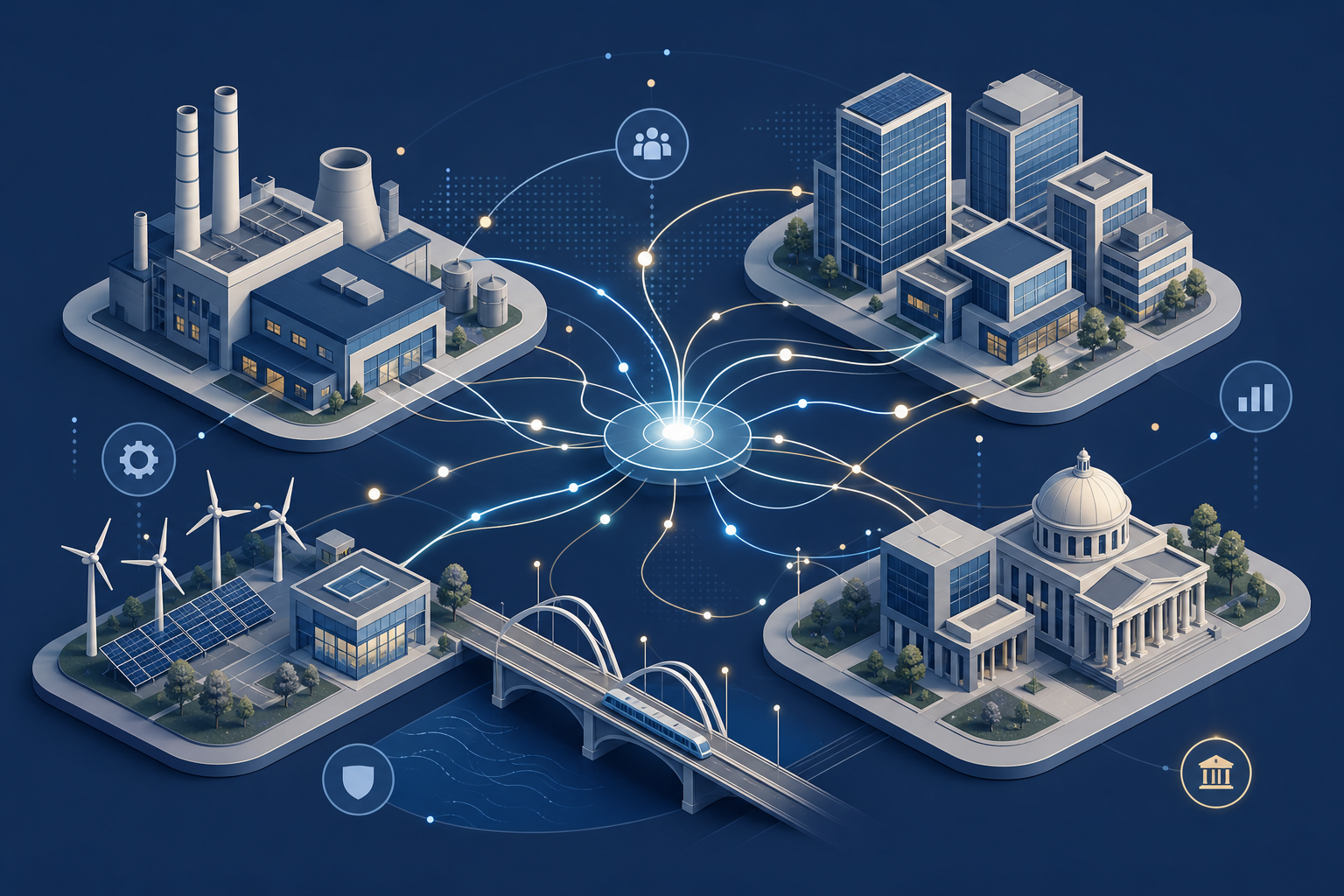
Supporting Innovation in the Built Asset Industry
Research Overview
At its core, IBDT aims to modernize how AI and data are used in buildings.
We study building data, explain performance drivers, predict future outcomes, and test operational scenarios virtually before real-world implementation.
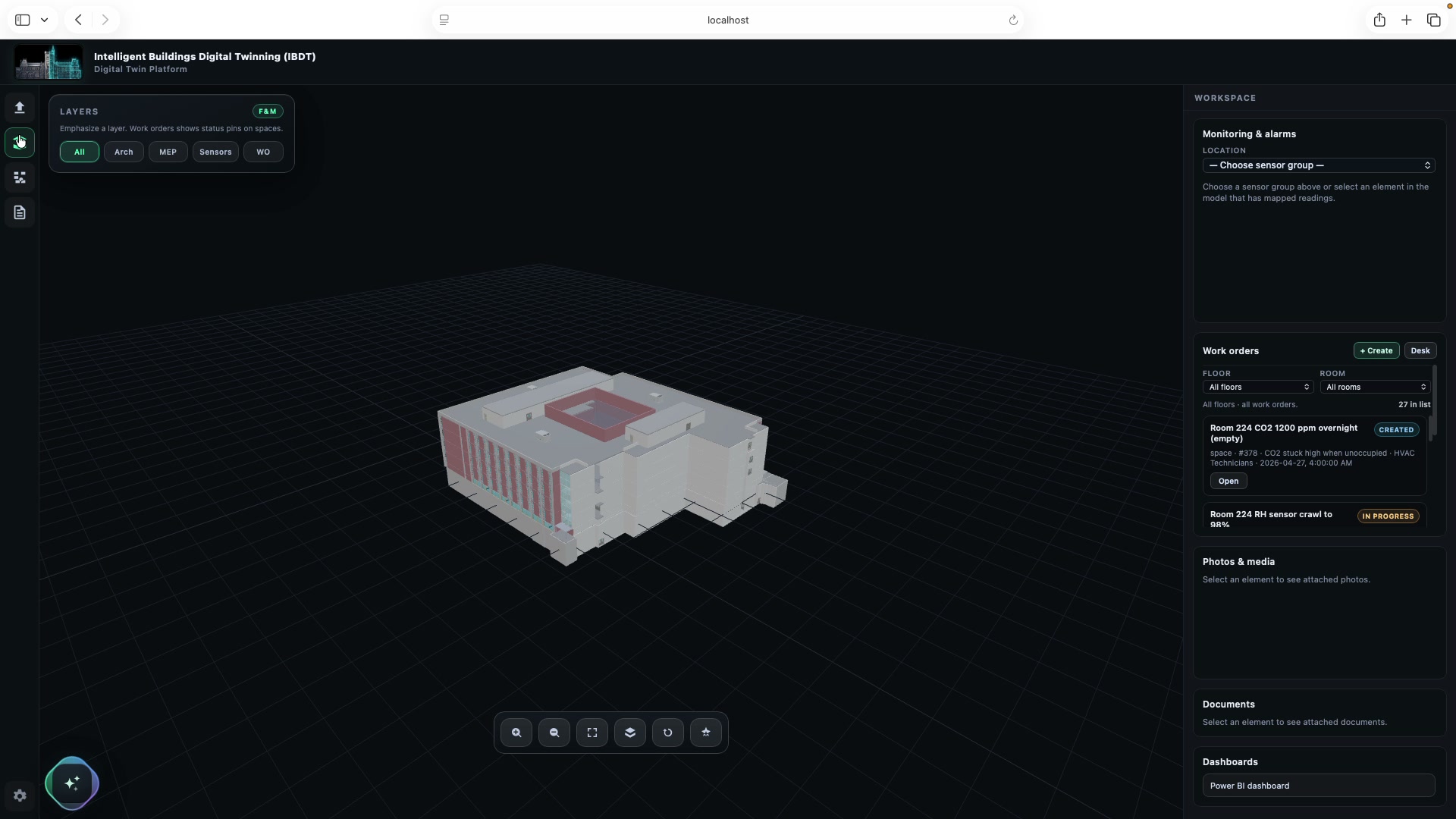
Alongside this research, we are building a UofT data portal to support easier, safer access to building information for users and researchers.
Intelligent Buildings and Digital Twins
Before discussing methods, we define two core ideas: intelligent buildings and digital twins.
Connected buildings collect data; smart buildings use that data for automation; intelligent buildings adapt operations to user needs, performance goals, and sustainability priorities.
At IBDT, a digital twin represents not only physical assets, but also processes and people. It combines analytics and collaboration to help teams compare options and make better decisions.
Why Do We Need Digital Twinning?
Digital twinning is needed because the stakes are high: large building portfolios, major retrofit requirements, and strong pressure to cut emissions.
Existing asset-management methods often remain reactive, costly, and difficult to scale. Better decision support can improve reliability, reduce lifecycle costs, and strengthen outcomes.
The path to productivity and decarbonization is still challenging due to system-level barriers.
-
Complex decision-making: many owners, contractors, and consultants still lack practical support for decarbonization planning and execution.
- Sociotechnical context: decisions depend on technical, financial, social, regulatory, and organizational factors.
- Context dependency: viable options vary by building type, local conditions, and stakeholder priorities.
-
Outdated supply chains:
- Fragmented structures: projects often run in isolated silos with short-term incentives.
- Risk-transfer contracting: adversarial procurement can limit trust and reduce innovation.
- Ad hoc processes: permitting, contracting, and delivery workflows are often inconsistent and slow.
-
Digitization backlog: while digitization can help, adoption still faces key barriers:
- Low adoption: digital tools are still underused across much of the sector.
- Limited audience: many tools target technical specialists, not owners or occupants.
- Technical bias: business-process and socio-economic needs are often overlooked.
- Top-down thinking: data and rules are often designed without enough learning from real operational context.
- Weak governance: outdated sharing practices and trust concerns still limit collaboration.
The Opportunity with the University of Toronto’s Digital Twin
Key strengths of our dataset include:
- Data triangulation: structured IoT data, unstructured logs/documents, and contextual building data.
- Data reliability: close work with operators provides stronger ground truth and practical validation.
- Higher-value data: broader research use supports new insights, simulations, and cross-domain applications.
- Occupants and user data: stronger inclusion of occupant perspectives enables more human-centered solutions.
Models in the Digital Twin?
A digital twin combines IoT, operational, management, and user data with technical models such as BIM and energy simulations. It supports four model types:
-
Descriptive models: explain current building conditions using live and historical data.
-
Predictive models: estimate likely future outcomes such as costs, risks, and maintenance events.
-
Prescriptive models: test "what-if" options to support better choices before implementation.
-
Generative models: explore new solution pathways and workflows that may be more efficient or resilient than conventional options.
Research Areas
Building rehabilitation requires better tools than simple rules of thumb. Decision-makers need ways to balance service, cost, energy, and climate outcomes.
Digital twinning helps teams compare lifecycle impacts before acting, improve execution quality, and reduce delays, risk, and cost.
UofT's multi-building dataset creates a strong foundation for testing and validating these methods in real conditions.
Empowerment
IBDT emphasizes co-creation and occupant empowerment, moving beyond passive consultation toward active participation in solution design.
Our long-term goal is to make advanced planning tools easier to use, so more people can explore decarbonization options and act with confidence.
Data Analytics and Machine Learning
For us, AI is about practical value: turning diverse real-world data into insights people can use through accessible tools and workflows.
Our ML agenda supports commissioning, sustainable operations, and stronger human-building interaction across four modes:
- Deployment: establish reliable systems for data collection, sharing, and access.
- Analytics: integrate IoT data, documents, and user input for predictive and prescriptive decision support.
- Experimental: test automation and streamlined information flows in real operational settings.
- Explorative: study emerging methods to advance adaptive, interactive, and intelligent building operations.
Data Governance & Policymaking
Data governance goes beyond access. It includes quality, policy, transparency, security, and the ability to turn data into decisions.
We work to demonstrate that responsible sharing can improve outcomes while still protecting privacy and security.
IBDT develops and tests governance best practices that support UofT's long-term data vision.